
Jake Cappadocia’s URO Presentation
September 22, 2026News0 Comments
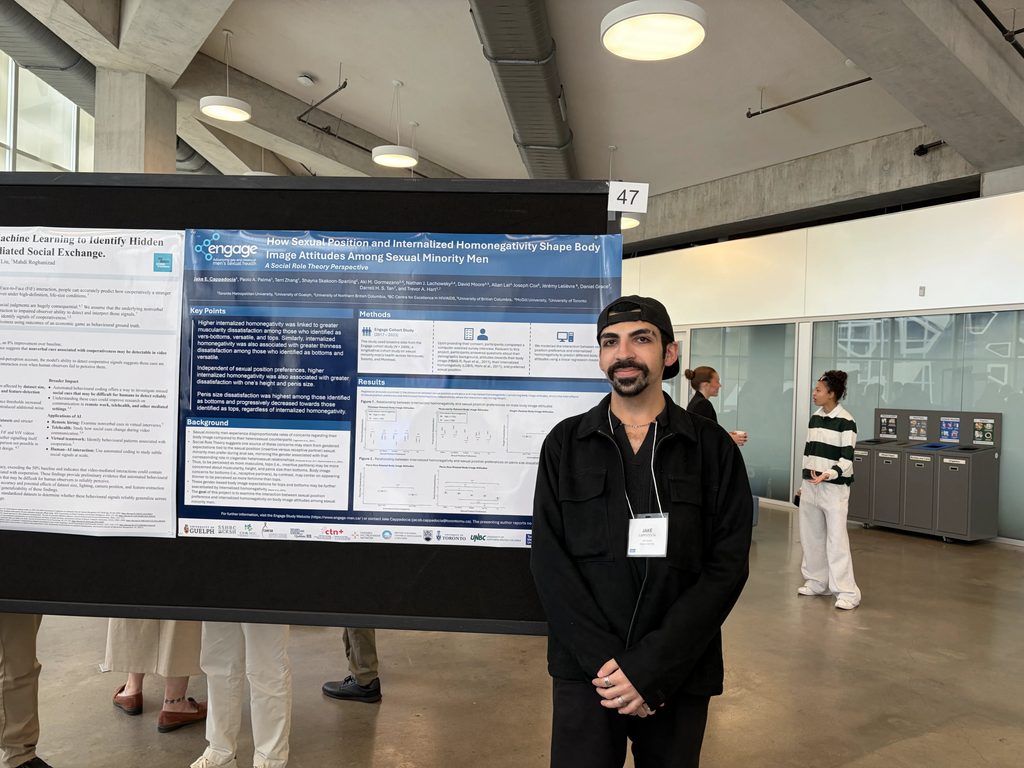
Jake Cappadocia presented his project, How Sexual Position and Internalized Homonegativity Shape Body Image Attitudes Among Sexual Minority Men, at TMU’s URO Student Poster Presentation Session. Dr. Trevor Hart and Dr. Paolo Palma co-supervised the project. For more information, please see the study abstract below.
Abstract:
Gay, bisexual, and other men who have sex with men (GBM) experience issues with their body image at higher rates compared to heterosexual men. One of the factors that may contribute to these body image issues are gendered stereotypes about their sexual behavior. Specifically, those who take on insertive roles during sex (tops) may face pressure to appear masculine, while receptive partners (bottoms) may face pressure to appear feminine, resulting in different body image issues where tops become more concerned about their height, muscle mass, and penis size and bottoms about body fat. Further, these issues may be intensified among those who experience greater internalized homonegativity (i.e., negative attitudes about one’s sexual orientation), as this has been found to be associated with endorsing heteronormative values around gender. To answer these questions, we analyzed the survey responses of 2,449 GBM from a psychosocial behavioral survey of GBM health across Vancouver, Toronto, and Montreal.
Consistent with our hypotheses, among GBM who reported higher internalized homonegativity, those who preferred to top reported greater dissatisfaction with their musculature, and those who preferred to bottom reported dissatisfaction with their body fat. Those who reported being versatile (i.e., preference for both roles) reported dissatisfaction with both. Interestingly, we found that higher internalized homonegativity was associated with greater dissatisfaction over one’s height and penis size regardless of preferred sexual position. Similarly, we found that people who preferred to bottom reported greater dissatisfaction with their penis size independent from their views about their sexual orientation. These findings have important implications on male body image issues among GBM. Past research has found that male body image issues tend to revolve around muscularity; our findings suggest that the unique stressors and circumstances of GBMs’ lives may shape their body image attitudes in more diverse ways. Specifically, internalized homonegativity may be a potential target for interventions aimed at improving body image attitudes among GBM.